
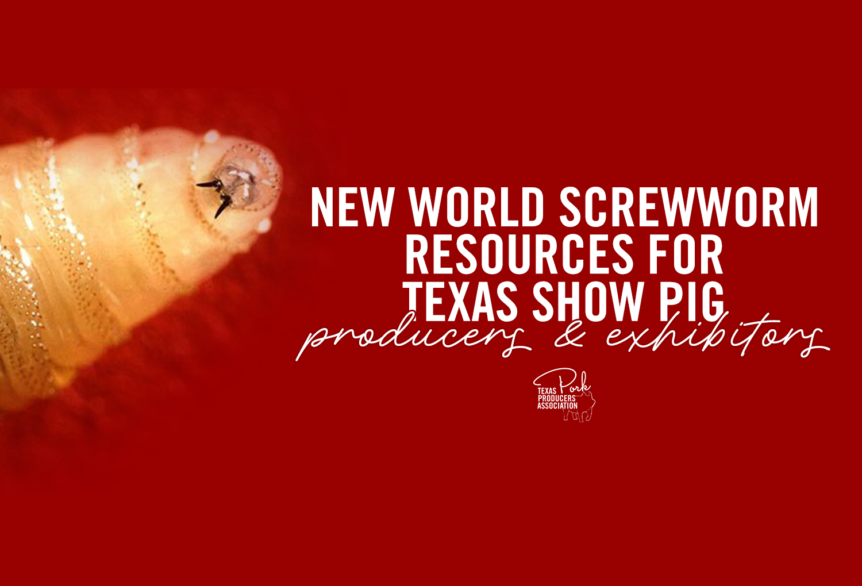
Protecting herd health starts with staying informed. With summer jackpots and farrowing season in full swing, it is crucial that Texas swine producers and exhibitors are educated on risks, management practices, surveillance, and treatment if a case were to occur.
We’re sharing proactive educational resources on New World screwworm (NWS) to help swine producers understand the pest, recognize potential signs, and know where to turn for additional information.
While New World screwworm has not been reported in any swine herds, education and awareness are key tools in safeguarding our animals and our industry. This information is intended to support preparedness efforts and ensure producers have access to the latest guidance and resources.
What is New World Screwworm?
According to Texas Agrilife Extension, the New World Screwworm (NWS) is a parasitic fly whose larvae feeds on living tissues of warm-blooded animals, which can occur in any broken or damaged skin. NWS was successfully eradicated from the United States and Mexico in the 1970s through the mass release of sterile male flies. However, a recent NWS from Panama through Mexico has brought concern to our country’s livestock production.
Risks and Management Practices that Could Attract NWS
Per the Texas Agrilife Extension factsheet and the Screwworm Coalition of Texas, various factors and swine management practices could cause breaks in the skin and risk exposure.
- Piglet processing, including ear notching or tagging, castration, tail docking, tattooing, or needle teeth clipping
- Vaccination or any needle injection
- Ear tagging
- Umbilical sites in newborn piglets
- Skin abrasions or wounds from external sources
- Ticks, lice, or rubbing sites
- Poor hygiene
A good rule of thumb during this outbreak is to closely monitor your swine, especially if they have an open wound or any other exposed areas of tissue.
Practical Prevention Practices
Per the Texas Animal Health Commission, the chances of finding a NWS fly are low, so producers are encouraged to remain watchful and report suspicious maggots on their animals. However, there are preventative measures to take into consideration.
Common practices such as quickly treating and sealing wounds to ensure that the fly has no viable host are key practices in preventing NWS in your operation. Times this would be beneficial include, but are not limited to:
- Covering the site of where you tagged your animal for validation and/or an 840 tag
- Sealing an open wound from rubbing sites
- Irritated vaccination sites
- Umbilical cord sites
It is highly recommended that producers and exhibitors work with their vet to determine what treatment products and methods to use. To find an accredited veterinarian near you, visit the USDA’s VSPS Veterinary Services Process Streamlining tool.
The Texas Pork Producers Association is dedicated to keeping our producers and exhibitors up to date with proactive education about NWS. All updates and information will be hosted on our New World Screwworm Resource page. For specific questions, please contact tppa@texaspork.org.